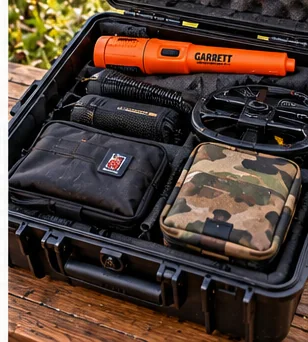
Condensation forms when cold gear meets warm, humid indoor air. The best fix is patience: leave the detector in its closed case in a cool room until it warms up, then wipe it down, open only what the manual allows and let it dry with airflow. Skip heat guns, damp bags and charging a cold battery.
In This Guide
Affiliate disclosure: We may earn a commission from qualifying purchases made through links on this page, at no extra cost to you.
Why gear fogs and drips when it comes inside
Warm indoor air carries more moisture than cold air can hold. When a detector that has spent hours in a freezing car or on a winter hunt comes into a warm house, the air touching its cold surfaces cools quickly and drops some of that moisture as water. You see it as a film of droplets on the shaft and coil, or as fog on a display. It is the same effect as a cold glass on a summer day.
Condensation is not a defect, and it is rarely an emergency. It becomes a problem when water settles into connectors, battery contacts, the headphone port or the gap between a coil and its cover, and then sits there. Over a season, that is how corrosion, flaky signals and chatter start. The fix is mostly patience and a short routine. Your manual is the authority on what your own model tolerates, so use this as a general checklist, not a rule for every machine.
Let it warm up slowly, in its case
The most useful habit is also the easiest. When you come in, leave the detector in its closed bag or case for a while in a cool room, such as an entry hall or a mudroom. A closed case warms slowly, and the cold surfaces inside it stay close to the temperature of the air around them, so less moisture lands on them. Opening the case straight away in a warm kitchen does the opposite: warm, humid air rushes in and meets cold metal and plastic.
How long this takes depends on the case, the room and how cold the gear got, so there is no number to quote. A sensible test is to touch the case and then the machine. When the machine no longer feels cold, it is much less likely to fog. Our cases, covers and storage guide and the backpack versus hard case comparison cover what kind of case suits your habits.
Drying it out safely
Once the gear has warmed up and any droplets have formed, the aim is to dry it gently. The usual list, in the order most people follow it:
- Wipe the outside. Use a clean, dry cloth on the shaft, armrest, coil and control box. Pay attention to seams, cam locks and the cuff.
- Open what the manual says is safe to open. That might be the battery door or the cover over a port. If your manual does not tell you to open something, leave it closed.
- Take out removable batteries. Dry the contacts and the compartment, and leave the door open while the machine rests.
- Lift off the coil cover and the control box cover. Moisture and sand trapped between cover and coil is a common cause of noise, so wipe both surfaces and let them air out.
- Dry the connectors and ports. Look into the coil connector, the headphone socket and the charging port for droplets. Dab, do not poke.
- Rest it in a dry room. Leave the machine on a clean towel in a spot with airflow, out of direct sun and away from heaters, until it is completely dry.
Then put it away, but not in a zipped bag while it is still damp. A closed case with damp gear in it is a small greenhouse. If you use a hard case, leave it open until the foam and the gear are dry.
What not to do
| Tempting shortcut | Why to skip it |
|---|---|
| Blow-drying the machine with a hair dryer or heat gun | Heat can warp plastic, soften adhesives and damage seals, and it can drive moisture into places you cannot see |
| Setting it on a radiator or in an oven | Uneven heat is hard on cables, coil shells and electronics; the manual rarely allows it |
| Charging a very cold battery right away | Check the manual first for charging temperature limits; a cold battery should warm up before it is charged |
| Switching it on to see whether it works | Power applied while moisture sits in a connector can cause a short or corrode contacts; let it dry first |
| Sealing damp gear in a bag | The moisture has nowhere to go and stays against the metal |
For the battery side of winter hunts, see our cold-weather battery guide and the general battery and charging guide. If a machine has been wet or very cold, give it time before you charge it.
When moisture is inside the housing
Surface droplets are normal. Fog or droplets inside a sealed housing, such as a display window or a headphone enclosure, are another matter. A sealed housing can trap damp air, and if it fogs inside it may mean a seal has aged or been damaged. Stop using the device, keep it somewhere dry and contact the maker or a repair service for guidance. Do not open sealed parts of the machine yourself unless the manual says you may.
The same goes for pinpointers, wireless headphones and the phone you carry in the field, since all of them can fog after a cold hunt. Let them come to room temperature before powering them or putting them on a charger.
Make it a habit, not a repair
A few small things cut down on the problem:
- Store the kit in a place that does not swing in temperature. A cold garage or hot attic is the hardest on gear. Check the manual for storage temperature guidance.
- Keep a drying kit in the bag. A small towel and a couple of desiccant packs take up almost no room.
- Dry gear after wet hunts the same day. Moisture that sits overnight is harder to deal with.
- Carry the kit inside, not in the trunk, between hunts if the weather is very cold and you have the choice.
Reusable desiccant packs
Look for packs sized for a small case or bag, and check whether they can be dried and reused. Keep them away from batteries and electronics in direct contact.
Microfiber drying towels
A soft, absorbent towel is the simplest drying tool. Pick a few small ones and keep them in the case.
For a full seasonal routine, our metal detector care guide covers coil, seals, batteries and storage in one place. If you were hunting in snow, the snow and ice gear checks covers keeping the machine dry in the field.
Bottom line
Condensation comes from moving cold gear into warm, humid air. Let the machine warm slowly in its closed case, then wipe it down, open only what the manual allows, and dry it in a spot with airflow. Skip heat guns, do not charge a cold battery before checking the manual and do not seal damp gear in a bag.
Frequently Asked Questions
Why does my metal detector get wet when I bring it inside?
Cold surfaces cool the warm indoor air that touches them, and the air drops some of its moisture as water. It is the same effect as a cold glass on a warm day.
Should I open the case right away when I come in?
It is better to leave the case closed in a cool room until the machine no longer feels cold. A closed case warms slowly, so less moisture lands on the cold gear.
Can I use a hair dryer to dry my detector?
It is best to avoid heat guns and hair dryers. Heat can warp plastic and damage seals and cables. Wipe it down and let it air dry in a room with airflow.
Can I charge my detector straight after a cold hunt?
Check the manual first for charging temperature limits. A cold or damp battery should warm up and dry before it is charged.
What if I see moisture inside the display or housing?
Stop using it, keep it dry and contact the maker or a repair service. Do not open sealed parts unless the manual says you may.
Sources and verification
This is general care advice drawn from how condensation works and from common storage habits. It quotes no manufacturer limits for storage, charging or humidity.
Check your manual for the storage and charging temperature ranges of your model, and for which compartments you may open. For moisture inside a sealed housing, contact the maker.
DetectorGear.co is a participant in the Amazon Services LLC Associates Program and the eBay Partner Network. When you purchase through links on this page, we may earn a commission at no additional cost to you. Affiliate relationships do not influence our editorial recommendations. Learn more.