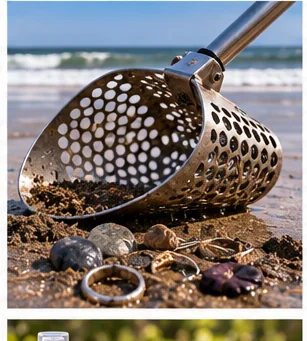
Products and configurations to compare
Stainless beach sand scoop
Rigid and corrosion resistant.
Best when: surf and packed wet sand
Watch for: heavier for long walks
Affiliate disclosure: We may earn a commission from qualifying purchases made through links on this page, at no extra cost to you.
Aluminum sand scoop
Easy to carry.
Best when: dry sand and casual beach hunting
Watch for: can deform under hard leverage
Titanium sand scoop
Low weight and excellent corrosion resistance.
Best when: serious beach hunters covering miles
Watch for: high cost
Hole size should match targets
Large openings drain fast but can lose tiny jewelry.
Toe plate changes digging leverage
A reinforced back edge lets you push into packed sand.
Handle material matters too
Carbon/fiberglass can save more swing weight.
Weld quality is a failure point
Saltwater stress exposes weak fabrication.
Rinse after every salt hunt
Even titanium setups have fasteners and handles that benefit.
Saltwater hunting stresses everything
Wet salt can destabilize single-frequency detectors, attack hardware and expose every weak point in a cheap accessory. Simultaneous multi-frequency machines such as EQUINOX 900, MANTICORE and Nokta Legend are designed to handle demanding ground and beach conditions more effectively than basic single-frequency machines.
Recovery equipment also changes. Stainless scoops tolerate salt but are heavy; aluminum is lighter but can bend; titanium combines strength and low corrosion with a premium price. A long handle reduces bending and lets you use body weight in wet sand.
Rinse after the beach
Even waterproof gear benefits from a fresh-water rinse after salt exposure. Pay special attention to coil covers, shaft joints, scoop welds and connectors where salt crystals can remain hidden.
Before checkout
- Accessory is compatible with the exact detector model
- Coil connector and firmware support are confirmed
- Waterproof rating matches the actual depth/use
- Wireless audio is low-latency enough for detecting
- Digging tool matches turf, field or beach conditions
- Finds pouch separates sharp trash from keepers
- Recovery tools have holsters or lanyards
- Saltwater gear can be rinsed and dried
- Added weight remains comfortable for multi-hour hunts
- The purchase solves a repeated field problem rather than duplicating existing gear
Buy the accessory that fixes the next hunt
Metal detecting gear is easy to overbuy because almost every accessory is cheaper than the detector. Before ordering, name the field problem in one sentence: “I lose targets in park trash,” “my scoop is exhausting in wet sand,” “my headphone cable snags,” or “the M15 makes my arm tired.” If the product does not fix that sentence directly, leave it in the cart.
Compatibility is the second filter. Detector families use model-specific coils, audio systems and waterproof connectors. Search by exact model and part family, not just brand. A Minelab accessory can still be wrong for another Minelab platform.
First-hunt test
Use new gear on a familiar site. Compare recovery speed, swing fatigue or audio timing against your old setup. Change one thing at a time so you know whether the new coil, headphones or harness actually helped. For beach gear, rinse and inspect it immediately after the first saltwater session to find corrosion-prone fasteners while the return window is still open.
The best accessories disappear into the routine. The target, site and permission should remain the interesting part.
Frequently asked questions
Best for wet sand?
Stainless is the usual value choice.
Lightest?
Titanium can be dramatically lighter for similar strength.
Is aluminum okay in surf?
Yes for lighter work, but repeated hard leverage can bend thin scoops.
What hole size?
Choose around target size and local sand/gravel.
Affiliate disclosure: DetectorGear.co participates in the Amazon Associates program and eBay Partner Network. We may earn from qualifying purchases at no extra cost to you. Amazon links use scouttheory-20; eBay links use campaign 5339137014.